Mental health in the nineteenth century was profoundly gendered. Women were thought to be naturally more emotional, irrational, and biologically unstable, a belief reinforced by longstanding myths that connected female mental illness to the reproductive system. These assumptions shaped both diagnostic categories and institutional practices. Symptoms like depression, use of abusive language, and suppressed menstruation were enough for a woman to be admitted. Women were diagnosed with insanity when they exhibited symptoms of overexertion, and diagnoses such as epilepsy and nymphomania were written off as bouts of insanity (Pouba and Tianen). An admissions file and record of patients admitted to Mendota Mental Asylum from 1869 to 1872 diagnosed women as insane for the following:
Insane by suppressed menses, Insane by religious matters, Insane by religious fantasy, Insane by domestic troubles, Insane by heredity, Insane by overexertion, Insane by abortion, Insane by loss of property, Insane by mental excitement, Insane by childbirth (Pouba and Tianen)
These women, ranging between the ages of seventeen and fifty-nine, were all admitted by their husbands. The fact that religious uncertainty, marital conflict, or physical exhaustion could be categorized as insanity demonstrates how psychiatric authority upheld patriarchal norms by disciplining women whose actions threatened social order.
A frequent symptom for admission was religious excitement, which included actions such as “religious fantasies” or “foolish romantic talk about the devil and Jesus” (Pouba and Tianen). These diagnoses were due to women having differing religious beliefs than the rest of society. Suppressed menstruation was another common symptom for admittance, due to the myth that insanity was connected to a woman’s reproductive organs. Hysteria was considered the first exclusively female mental disorder. It was first described by the ancient Egyptians in the Kahun Papyrus—a medical document dating to 1900 BC—and said to be caused by “spontaneous uterus movement within the female body” (Tasca et al). Plato argued that the idea of female madness related to the lack of a normal sexual life. He, Aristotle, and Hippocrates said that “the uterus is sad and unfortunate when it does not join with the male and does not give rise to a new birth” (Tasca et al). Even well into the nineteenth century, physicians—including Freud—interpreted hysteria as the result of sexual dissatisfaction, repressed desire, or the failure to fulfill one’s maternal role. It was only until Freud declared that he himself had become hysterical that the theory of “male hysteria” emerged. Freud wrote, “After a period of good humor, I now have a crisis of unhappiness. The chief patient I am worried about today is myself. My little hysteria, which was much enhanced by work, took a step forward” (Tasca et al). He argued that hysteria was a disorder caused by a lack of libidinal evolution and that hysteria was a result of being unable to satisfy sexual desires because of unresolved issues from the Oedipal conflict. The symptoms show up as a “primary benefit,” letting the person release their pent-up sexual energy. A “secondary benefit” of the symptoms helps the person get attention or influence others to meet their needs (Tasca et al). Historically, hysteria was thought to be a woman’s disease, which reflected the old-fashioned view of women’s roles at the time. Women were seen as powerless and only able to get what they wanted through subtle or manipulative behavior. This idea connects back to the old stereotype of the “possessed woman.”
For centuries, Western culture associated women with greater susceptibility to demonic possession, based on the belief that their minds and bodies were inherently more “porous” and vulnerable than men’s. Early modern medical and theological discourses often characterized female anatomy, especially the reproductive system, as a site of spiritual and physical permeability, making women more prone to supernatural intrusion (Brogan). The view was reinforced by the assumption that women’s emotional volatility, menstruation, pregnancy, and sexuality rendered them spiritually weaker and more likely to be overwhelmed by evil forces (Katajala-Peltomaa). In possession narratives, women who deviated from expected behavior—speaking too much, expressing anger, or defying domestic roles—were frequently interpreted as morally or spiritually compromised. Such deviance was medicalized or demonized as evidence of possession (Katajala-Peltomaa). Symptoms that modern medicine would recognize as physiological or neurological (for example, seizures, dissociation, compulsive speech, depression, or trauma responses) were interpreted as signs of demonic intrusion. This stereotype of the “possessed woman” persisted because it conveniently explained any behavior that defied patriarchal expectations. Women who were mentally ill, traumatized, rebellious, or simply unconventional could be “demonically possessed.”
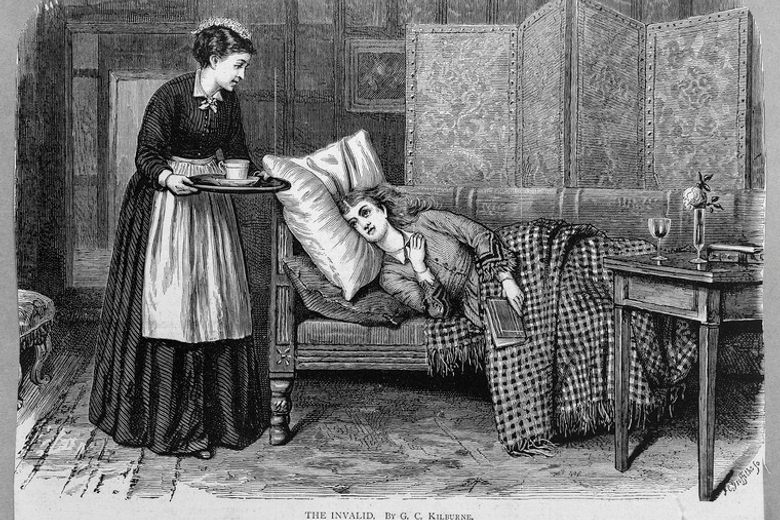
The rest cure was designed to treat “neurasthenia,” which was an umbrella term for a number of nonpsychotic emotional disorders that were not understood at the time (Martin). Today, neurasthenia’s symptoms would include depression, insomnia, anxiety, and migraines (Stiles.) The cure was created by American neurologist Silas Weir Mitchell in the nineteenth century for, in his own words, “nervous women, who, as a rule, are thin and lack blood” (Martin). His description already reveals the gendered assumptions shaping nineteenth-century psychiatric care: emotional distress in women was seen not as a result of social, psychological, or reproductive strain, but as a weakness inherent to female biology. The structure of the rest cure reflected these sexist assumptions. It required complete physical passivity. The patient was instructed to lie in bed for twenty-four hours each day, for up to months at a time. Social isolation was mandatory as contact with family and friends was strictly forbidden. Intellectual activity was discouraged or banned outright. Even eating was heavily regulated. For the first week of the cure, the patient was only allowed to drink milk. If they could not tolerate the milk, it was substituted for eighteen or more raw eggs a day (Martin).
Psychological manipulation was crucial to the rest cure. Mitchell openly stated that his success depended on “the moral methods of obtaining confidence and ensuring a childlike acquiescence in every needed measure” (Martin). His language reflects a broader cultural pattern in which women’s mental distress was framed as disobedience or immaturity rather than as legitimate suffering. Mitchell’s own commentary about his patients underscores this attitude. He referred to one woman as “a pallid, feeble creature… and had no more bosom than the average chicken of a boardinghouse table. Nature had wisely prohibited this being from increasing her breed” (Martin). Statements like these reveal a striking level of contempt, implying that some women were biologically unfit for reproduction or full participation in society. Such remarks show that Mitchell viewed his patients not as individuals deserving relief but as flawed bodies in need of control. Despite the cruelty embedded in his method, Mitchell remained widely admired. His charisma, professional status, and confidence encouraged many women to trust him, even when his treatments harmed them. This contradiction between Mitchell’s disdainful private views and the loyalty he received from patients highlights the power imbalance that defined nineteenth-century medicine. Women were expected to submit to male authority, even when that authority dismissed their experiences or worsened their suffering. The rest cure thus illustrated not only flawed medical practice, but also the cultural structures that shaped women’s mental health care: structures rooted in gender, obedience, and the belief that emotional distress should be contained rather than understood.
Interestingly, Mitchell also had a method for treating men with the same medical condition of neurasthenia. Instead of prescribing them the “rest cure” as he would with women of the same symptoms, Mitchell would treat men with the “west cure.” He would send anxious men out West to “engage in prolonged periods of cattle roping, hunting, roughriding and male bonding” (Stiles). These activities were believed to restore masculine vitality and counteract what he saw as the emasculating effects of nervous illness. While women were not allowed to engage in any physical or intellectual activities while on the rest cure (such as reading or writing), men were encouraged to engage in vigorous physical activity out West and to write about their experience. Mitchell believed that these men could strengthen their nervous systems by engaging in “a sturdy context with Nature,” and that their masculinity had been weakened by “the feminizing effects of nervous illness” (Stiles). Mitchell claimed that “under great nervous stress, the strong man becomes like the average woman” (Stiles), which exposes the deeply embedded gender hierarchy in nineteenth-century medical thought. Illness in women was seen as confirmation of their inherent fragility, and the same illness in men was interpreted as a temporary lapse in masculinity that could be reversed through physical dominance, outdoor labor, and camaraderie with other men. In other words, men were allowed to regain selfhood by expanding outward into the world, while women were expected to recover by shrinking into domestic confinement.
The outcomes of these two treatments were, unsurprisingly, radically different. Rest cure patients often experienced worsening symptoms like heightened depression, increased anxiety, cognitive decline, and sometimes, full psychological collapse. By contrast, men sent on the west cure typically returned with improved moods, renewed confidence, and stronger physical health. Walt Whitman described a friend who had undergone the west cure as “built up miraculously” (Stiles). The cure was so successful for men that Mitchell even prescribed it to himself. After self-diagnosing himself with neurasthenia, he made camping and fishing expeditions in the Western United States and Canada nearly every year. He saw these trips as “a necessary respite from his intellectual pursuits and as a means of preventing nervous breakdowns” (Stiles). His enthusiastic embrace of the west cure underscores his belief that men required stimulation, independence, and engagement with the natural world in order to maintain mental stability, beliefs he pointedly did not apply to women.
The stark contrast between the rest cure and the west cure reveals far more than differing medical strategies; it exposes the gendered logic at the heart of nineteenth-century psychiatric treatment. Women’s suffering was pathologized as weakness and treated with restriction, infantilization, and erasure of identity. Men’s suffering, however, was viewed as a disruption of their expected social power, something to be repaired by granting them physical freedom and opportunities for self-assertion. These treatments not only reflect contemporary assumptions about gender and mental health but also illustrate how medical practice actively reinforced those assumptions, shaping the lived realities of countless patients.